

Words
At its heart, language is a system for transferring ideas from one mind to another.
Words are the vessels that carry those ideas. Without words, you have no meaning to transfer.
You can think of grammar as the engine that organizes the words, but the words themselves are the fuel.
Grammar
Grammar is the engine that makes communication clear, effective, and meaningful. It’s the tool that turns a jumble of words into a meaningful message.
It’s the difference between being understood and being truly understood.
Listening
Listening is the gateway to natural, fluent English.
It’s not a passive activity; it’s an active process of building the mental framework of the language in your brain.
By prioritizing listening, you make speaking, reading, and writing easier and more intuitive.
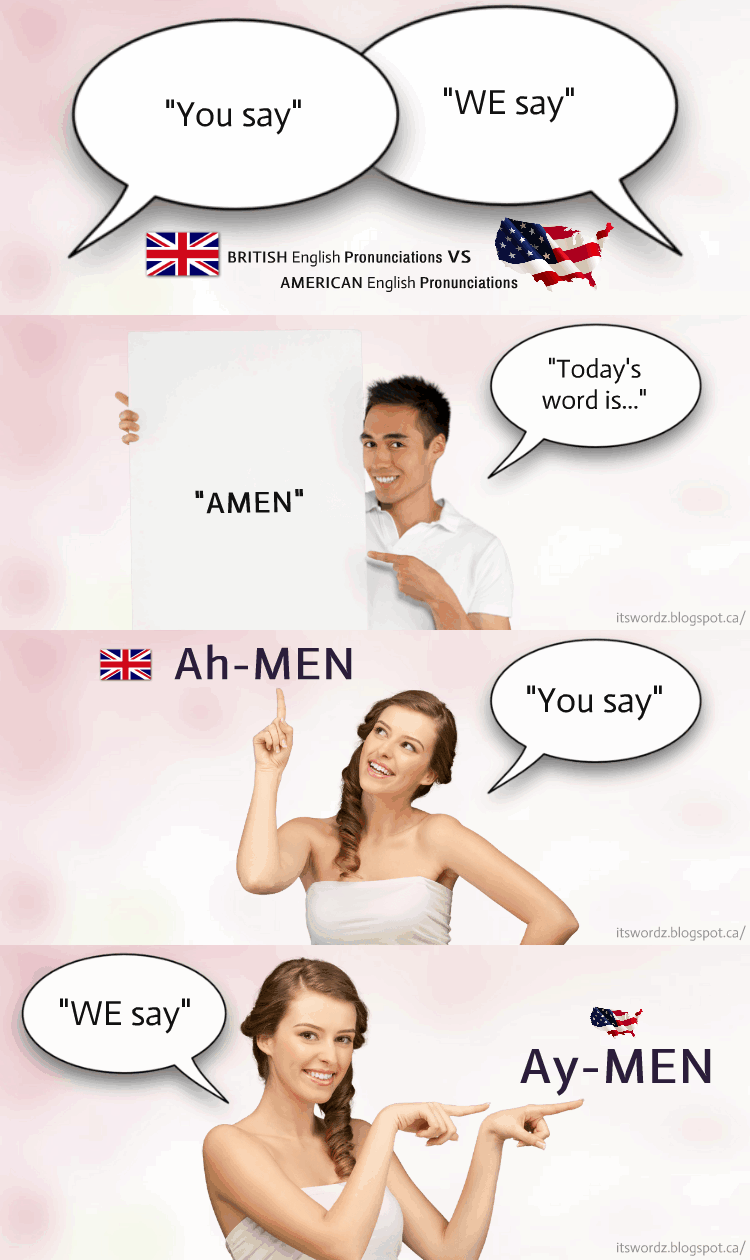
Speaking
As a productive skill, speaking is the primary tool for communication and it accelerates overall language acquisition. Speaking creates a feedback loop that is essential for improvement, builds automaticity and fluency, and especially deeply reinforces words and grammar.
Reading
Reading is a foundational skill that supports listening, speaking, writing, and translating.
It’s the immersive activity that builds a deep, intuitive understanding and fluency that is hard to achieve through any other means. Its importance goes far beyond simply understanding words on a page.Reading is one of the most effective and essential activities for mastering English.

Writing
Writing is important in English learning because it is the engine of conscious and deliberate practice.
It’s the skill that forces you to slow down, think critically, and actively construct the language, which in turn reinforces your learning, improves your accuracy, and ultimately makes you a more confident and capable communicator in all areas of English.
As a productive skill, writing is often seen as one of the most challenging skills to master in any languages.
Its importance goes far beyond just being able to compose an English essay or email.
Translating
As a language skill, translation is important because it is the ultimate act of communication across a linguistic barrier. For a learner, it’s the ultimate test of skill. For the world, it is the essential tool that allows ideas, knowledge, and culture to flow freely, making our world a little smaller and a lot more connected.
Copyright © 2026 安迪小站 | All Rights Reserved
浙ICP备2025216259号 | 浙公网安备33040202001082号